Southampton has more medieval city walls still standing than any other city in the country – and with the recent unveiling of the new development to the east of the Bargate, we now have even more of the walls to explore.
I regularly take tours looking at the wall along the north from the Bargate – with John le Fleming peering across the top – and ending in the 13th Century north-west tower. Formally known as Arundel Tower – probably named after one of the 14th Century governors of Southampton’s royal castle – it is of course ‘properly’ known as Wind Whistle Tower.
The walls along the west, built on the orders of King Edward III after the devastating raid by the French in 1338, incorporate the 12th Century King’s or Castle vault – and stretch along to the Arcades. The 13th Century Westgate, through which many of Henry V’s ‘band of brothers’ marched on their way to the Battle of Agincourt in 1415, two centuries later saw the Pilgrim Fathers board the Mayflower and the Speedwell before embarking on their journey to America.
And along the south walls, there’s God’s House Tower, built in 1189 and named after the nearby God’s House Hospital.
At one time Southampton’s city walls extended for almost 1 ¼ continuous miles, with 29 towers and seven gateways, and are approximately 6ft thick, and range in height from 12ft to more than 20ft.
We are so lucky to have such an amazing historical legacy.
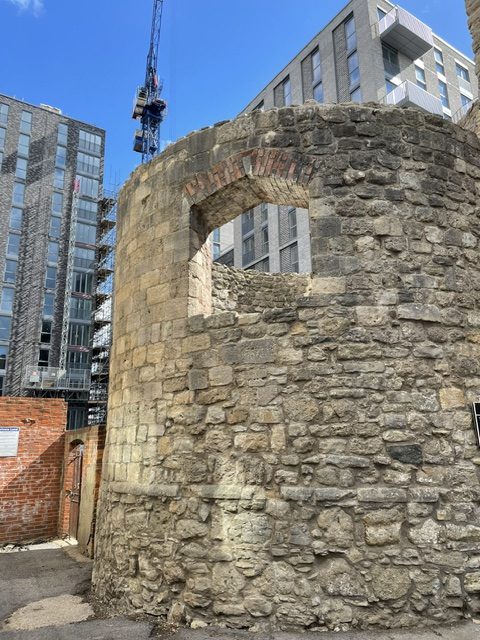
And I’m very much looking forward to incorporating visits to the walls along the northern part to the east of the Bargate, and those along the eastern side, once the new development is fully finished. For example, we can see a bit of Polymond Tower in the north-east corner, named after 14th Century mayor John Polymond and also known as St Denys Tower, as the St Denys Priory was responsible for looking after the tower, and it will be great to be able to explore it properly.

