Walking Tours of Southampton, Winchester and Salisbury

I love delivering walking tours of these amazing cities. They’re so different to each other, but each with so many surprises. It’s fascinating to watch everyone’s reaction, especially when seeing the less well-known and sometimes hidden buildings and tucked away streets, and hearing intriguing – sometimes mind-boggling – stories.  

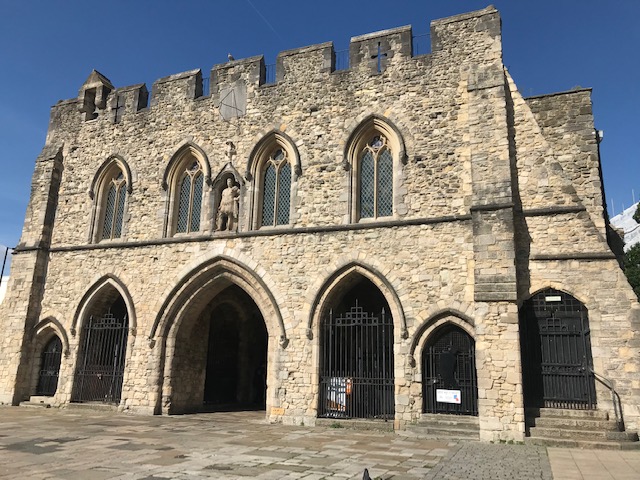
While Southampton’s Bargate is definitely a well-known – and well-loved – feature in the city, the extent of the medieval walls and vaults, the previous existence of a royal castle and gothic mansion in the centre of the old city all come as a big surprise. There are the personal stories surrounding the sinking of the Titanic in 1912 – with over 700 of the 900-strong crew having come from Southampton – and the legacy of the city’s Second World War experiences.

Royal associations abound when talking about Winchester, and the country’s previous capital city. Along with the 11th century cathedral and 13th century Great Hall – once part of an imposing strongly defended castle, and now home to the round table of Arthurian legend – there’s the 14th century Winchester College, the ruins of a once sumptuous bishop’s palace, and the last home of 18th century novelist Jane Austen to see.

Salisbury’s history starts with the founding of the Cathedral in 1220 and the curious story of the bishop and the bow and arrow … The importance of the city’s wool trade, the 15th century Doom painting in the church older than the Cathedral, pilgrims’ badges scooped from the canals once earning Salisbury the name ‘Venice of the South’, and a 1483 execution – all stories that help make up the fascinating history of the city.

I offer city and site tours across the South Central region – Hampshire, Dorset and Wiltshire – as well as in Windsor and Eton – and can also tailor tours to specific interests, and so please do get in touch if you’d like more information.

Tour-guiding in Windsor and Eton

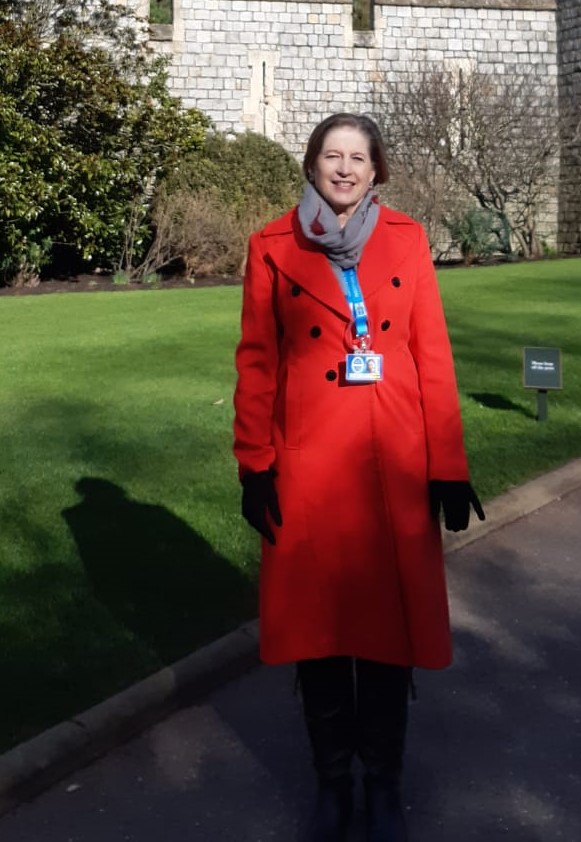
I’m absolutely delighted to have passed the Windsor and Eton Endorsement Course, and to now be able to guide in Windsor – at the Castle, in the town, and in Windsor Great Park – and in Eton.

Windsor is one of those towns that grew up around a historic building – in Windsor’s case, Windsor Castle, and built on the orders of William the Conqueror at the end of the 11th century. There is such a wealth of history attached to the Castle from its early days to the time of Edward III and the founding of the Order of the Garter in 1348, to the changes made by King George IV in the 19th century, and the restoration after the 1992 fire.

And the beautiful parkland in the Great Park – such as Savill Gardens, Virginia Water, Valley Gardens the Long Walk with the Copper Horse statue of King George III at the end – offers the perfect space for walking and getting away from it all. The fields of Runnymede are also a must-see, where King John gave his seal to the Magna Carta in 1215, the event commemorated by the Magna Carta Memorial and which sits alongside the Commonwealth Air Forces Memorial and the Kennedy Memorial, remembering the life of the assassinated American President, John F Kennedy.

Across the Thames from Windsor, Eton is most famous as the home of Eton College founded by King Henry VI in 1440 and with 21 of the UK’s prime ministers being Old Etonians. Eton itself is charming and well worth a walk through the streets – as is a tour of Windsor, with historic buildings ranging from Charles II’s mistress Nell Gwynne’s house, to the historic Guildhall dating from the 1680s, and where King Charles III married Queen Camilla in 2005.

In addition to guiding across Hampshire, Dorset and Wiltshire, I’m now looking forward to doing walks and tours in Windsor and Eton.

If you’re interested in doing a guided tour in Hampshire, Dorset, Wiltshire – in any of the cities, towns, or historic buildings – or in Windsor and Eton, please do get in touch.

Thank you to Hanwell WI

Thank you to Hanwell WI (Women’s Institute) for being so welcoming yesterday evening. It was lovely to meet you all – and I’m so glad that you enjoyed my talk about A Weekend to Pack.

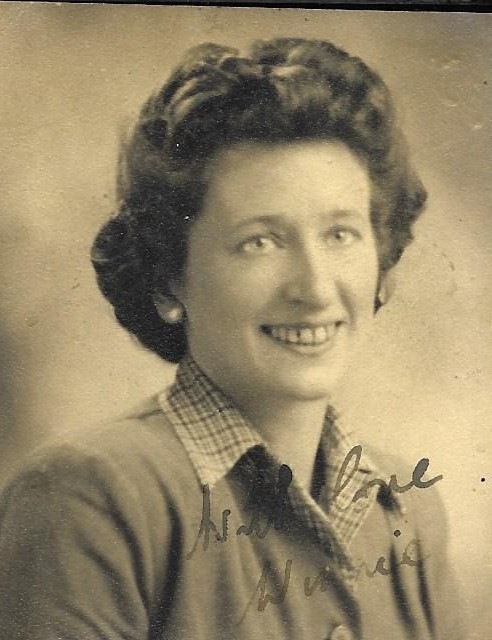
It was very special, too, to be talking about one of the letters from George’s sister, Winnie – written not five miles from Hanwell WI’s meeting venue at the William Hobbayne Centre in St Dunstan’s Road – albeit written from a distance of over 80 years.


Following the ‘evacuation crisis’ of July 1940, letters were the only form of communication available to the separated families. And while most of the letters sent between the ‘bachelor’ husbands and the evacuees were about life in Hong Kong and all the news from Australia, the families’ lives were set against the backdrop of the home country at war.

There was concern for the progress of the war, concern for families and friends in the services, and increasingly for family and friends back home in the UK, particularly after the start of the Blitz and the German bombing raids in 1940.

Winnie and her husband, George’s brother-in-law, Sid, lived at 83 College Road, Isleworth, and it’s from there that Winnie writes about one raid in November 1940:

 Sometimes I think mentally it is worse for you and Hilda to be separated as you are than for us, Sid and me, facing the bombs together. That looks a bit like heroics written down, but one does feel better together. I find that on ‘home guard’ nights, of which tonight is one, I simply loathe it. I have a friend up to sleep with me, and we are already ensconced in the air raid shelter, hence the pencil. I brought a fountain pen with me, but I was a bit delayed in coming out, and then a Nazi plane appeared and the guns thundered out so I took to my heels and on the way in my haste I dropped it, and as it is past ‘black out’ I can’t look for it ‘til the morning, as they are very fussy over using torches nowadays.

We sleep in the shelter every night, as we have had a lot of bombs dropped in this district, and quite a lot of damage has been done. Practically every night they drop a few round about us, but of course we are not one of the worst districts by any means. I expect the people in the East End would think we have had nothing.

It was lovely to know that so many from the Hanwell WI knew Isleworth well, and College Road – and I’m sure Winnie would have been delighted to know that people were ‘reading’ part of her letter 80 plus years on.

So, thank you again, to all at Hanwell WI for letting me share George and Hilda’s story with you – and some of Isleworth’s Winnie and Sid’s.

Receiving my ITG Blue Badge!

The Medieval Hall in Salisbury was the most delightful – and appropriate – setting for the Celebration Evening on Saturday 7 October 2023, marking the end of the South Central Blue Badge training course.

It was a wonderful evening with speeches from Alistair Chisholm – Dorchester Mayor, Town Crier and Blue Badge guide – as well as from various people from the ITG (Institute of Tourist Guiding), and a chance to see again so many of the guides who’d helped tutor and train us during the course.

And it was very exciting to receive our ITG badges, and our certificate from Time Team archaeologist, Phil Harding.

And congratulations to all my fellow new South Central Blue Badge guides!

Bitterne Library Short Story Competition 2023

I’m really looking forward to judging the entries for Southampton Bitterne Library’s short story competition.

The theme is ‘Libraries’ and the closing date is Monday 31 July 2023 – and so if you haven’t submitted an entry yet, there’s still time!

Entries must be no more than 1,000 words and can be hand-written or typed, and submitted by hand or via email to elizabeth.pinchen@southampton.gov.uk or to andrea.withey@southampton.gov.uk.

The competition is part of Bitterne Library’s 60th anniversary celebrations – and there’s a £25 book voucher for the winner, to be announced at the 60th Anniversary Garden Party on Saturday 9 September 2023.

This competition is for over 16s, but there’s a children’s writing competition too, and you can find out more information for both competitions at Bitterne Library.

I can’t remember a time when I didn’t belong to a library! As a child we had cardboard tickets, with one inserted into the borrowed book’s docket and kept inside the library, and the return date stamped inside a label inside the book. There were no online renewals, email reminders or self-service check-in and check-outs.

But what hasn’t changed is books on shelves! Whether it’s non-fiction or fiction and whatever the subject or genre, libraries are the most amazing source for information, entertainment, enjoyment. And today’s libraries offer even more with computers and internet access, groups and clubs.

And so much inspiration for those short stories! I can’t wait to read them.

Bitterne Library Talk Tuesday 4 April 2023, 7pm

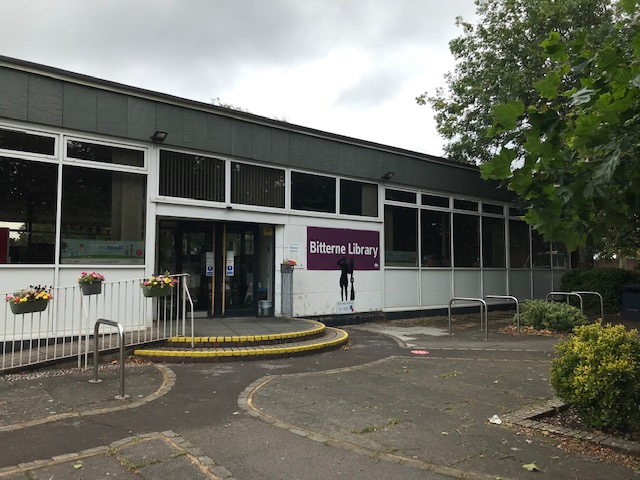
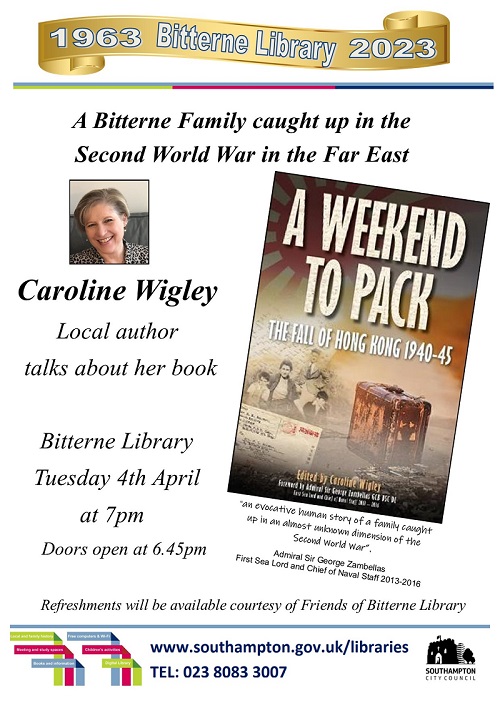
I’m delighted to have been invited to speak at Bitterne Library on Tuesday 4 April 2023, 7pm, and helping to celebrate the library’s 60 years!

As a writer and avid reader – of fiction and non-fiction – I’ve been a member of a library ‘for ever’. The weekly Saturday treat as a child was the visit to the local library in Camberley, although Surrey County Council refused to stock Enid Blyton in those days, much to my disappointment…

But I know what a wonderful resource libraries are and so it’s very exciting to be speaking at Bitterne’s 60th anniversary about A Weekend to Pack and the story of Bitterne’s Bearman family in the Far East during the second World War.

Bitterne Library opened in 1963, and according to Sotonopedia, was the first to be built after the end of the Second World War in 1945, and was originally called Eastern Library. Prior to that there’d been a part-time service 1922-1939 run from St Martin Church Hall in Brook Road, Bitterne, and in 1939 a ‘Bitterne Library’ opened in Cobbett Road. This was subsequently renamed Cobbett Road Library, and today’s Bitterne Library at Bitterne Road East, took over the name.

Eighty-two years ago in April, George Bearman when writing to his wife Hilda, was reflecting on the nine months since the threats of invasion from Japan had seen 3,500 women and children sail from Hong Kong. All had thought that this evacuation would be short-lived, but there they were, in April 1941, George with his fellow ‘bachelors’ in Hong Kong, Hilda and the boys now down in Sydney Australia.

And in April 1941, George was certainly feeling un-optimistic about the return of the evacuees:

“The Balkan news is bad again tonight and it looks as though we shall be right out of Greece by the time you read this. No, I certainly think you can wash out April as a travelling month, May too for that matter – I’ve reached that state of mind when I think it’s hopeless to attempt to forecast any date, but keep on smiling dear, it’s bound to come one day.”

And, of course, Hong Kong and the Far East was sliding towards war, and there were a few months and years to come before any hope of reuniting families.  

I’m looking forward to sharing the Bearman family’s wartime story on Tuesday 4 April 2023. The event is free and starts at 7pm, at Bitterne Library, Bitterne Road East, SO18 5EG.

Bitterne Local History Society Talk – Saturday 12 November 2022

A Weekend to Pack: The Fall of Hong Kong (1940 – 1945) – A Bitterne family caught up in the Second World War in the Far East
Saturday 12 November 2022, 7pm
Bitterne United Reformed Church, 446 Bitterne Road, Southampton, SO18 5EF

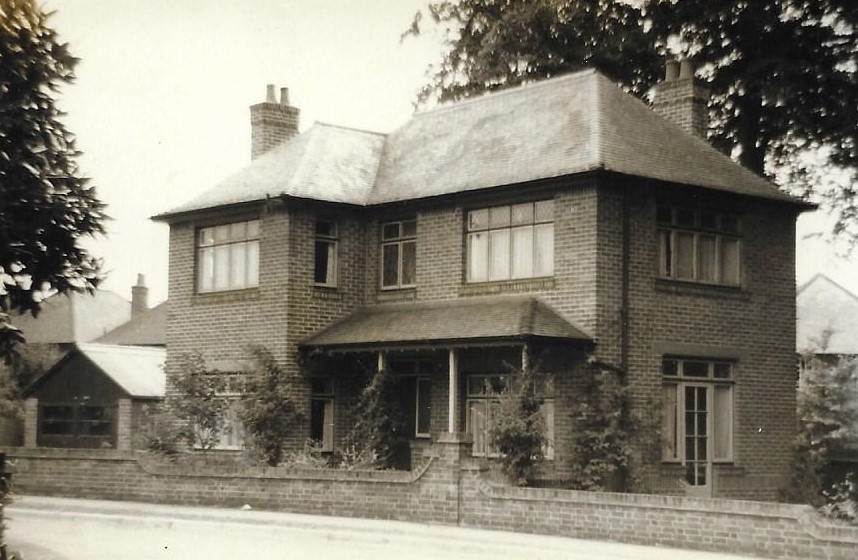
The house in the photograph is the Bearman family home. It’s in Redlands Drive, Bitterne – and I’m delighted to have been invited by Bitterne Local History Society to talk about the Bearman family’s wartime story.

George and Hilda Bearman were married at Jesus Chapel, St Mary Extra – now Peartree Church – in Southampton on Saturday 24 July 1926. Hilda had grown up in the city, and although George and Hilda began married life in Portsmouth where George was an electrical engineer at the Royal Dockyard, they maintained strong links with Southampton. Hilda’s parents’ home was in the city and the family returned to the UK and Bitterne in 1945.

It was in the late 1930s, that the family sailed for the Far East and Hong Kong.

The Second World War did not come officially to the Far East until December 1941, when the Japanese attacked the Americans at Pearl Harbor, and the British colonies Malaya (Malaysia), Singapore, Burma (Myanmar) and on 8 December, Hong Kong.

But the Bearman family wartime story along with that of many of those in Hong Kong began 18 months earlier, and the week of 1 July 1940 which, following threats of invasion from the Japanese, saw the shock evacuation – after only a weekend to pack – of almost 3,500 women and children.

We followed you down the harbour to Lyemoon and then you disappeared in sheets of rain. We all stood up and got nicely wet trying to peer through the rain to see the last of the ship and then we gave it all up and turned back.

Oh, my dear, what a Monday that was. In fact what a weekend! But perhaps the rush was all for the best as it didn’t leave us a lot of time to think of ourselves.

Few believed the evacuation to be necessary, virtually all that it would be short-lived, but when George wrote to Hilda of watching the Empress of Japan sail from harbour with Hilda, David and Edward on board on that Monday 1 July, it was the first of many letters he would write stretching down the years – with the home country at war in Europe, and tension with Japan growing.

In my talk I’ll be covering the story of the evacuees as they travelled from billet to billet, at first in the Philippines and then in Australia, and that of George and his fellow colleagues remaining in Hong Kong – both before the eventual attack by Japan, and in the years following Britain’s surrender on 25 December 1941.

Tickets are £3 (£1 of you’re a Society member) and you can find more information about the evening on the Bitterne Local History Society website.

1 July 2022 – 25 years since the return of Hong Kong to China, 82 years since the first evacuation ship sailed in 1940

Today, 1 July 2022, marks 25 years since Hong Kong was handed back to China after 156 years as a British colony.

The handover ceremony – attended by Prince Charles, the UK’s then Prime Minister, Tony Blair, and the Chinese President Jiang Zemin – began on 30 June 1997. At midnight Chris Patten as the 28th and last Governor of Hong Kong sent the telegram confirming, “I have relinquished the administration of this government.” He then joined Prince Charles on HMY Britannia to slip away out of Victoria Harbour and away from Hong Kong.

For many, 1 July is another anniversary, marking the day on which another ship sailed from Victoria Harbour, and away from Hong Kong.

Because, 57 years before that handover date in 1997 – 82 years ago today – on 1 July 1940 the Empress of Japan sailed with 1,500 British women and children on board, evacuated from the colony following threats of attack from Japan. That week beginning 1 July 1940 would see almost 3,500 women and children become evacuees.

Few in the colony believed the evacuation to be necessary, most that it would be short-lived. But after an initial stay in the Philippines, the evacuees were on their way again, bound for Australia, and the weeks of separation were about to stretch into months and years.

Among those on that first ship to leave Hong Kong on 1 July 1940 were Hilda, David (11) and Edward (9) – the wife and sons of naval dockyard electrical engineer, George Bearman.

In the months and years to follow, George’s letters capture what life was like for the husbands and fathers left in Hong Kong: abruptly returned to ‘bachelorhood’ and uniquely ‘keeping the home fires burning’; trying to keep up morale, while coping with the loneliness of separation and against the backdrop of the home country at war, and slide to war in the Far East; through the long dark years following the Japanese invasion, December 1941.  

For many of the evacuees, 1 July 1940 came to be not only the day on which they boarded ship and sailed away from Hong Kong, but the last day on which they saw their husband and father.  

“I’ve just been playing that silly game of being sorry for myself”

On 19 April 1941, George begins his letter to Hilda: 

“It’s 6 o’clock Saturday evening, and I’m writing in the office while waiting for my lads to come back – yes, I’ve been working this afternoon and now it’s nearly time to pack up.

“I’ve just been playing that silly game of being sorry for myself – I pictured my going home presently, spotting you as the ferry neared the pier and then the walk home together, some supper and then off to the pictures somewhere – well, I probably will do those things except the seeing and meeting you.”

In 1941, letters were the only source of communication between the men in Hong Kong and their families evacuated to Australia.

The separation caused by the July 1940 ‘evacuation crisis’ following the threat of invasion from Japan had not turned out to be ‘short-lived’ as most in the colony had envisaged. By April 1941, the evacuees had been away for nine months.  

There was no texting, or instant messaging back then – not even phone calls possible across the distance in 1941. Pen and paper were the only option.

And for the men left behind in Hong Kong, separation was growing ever more poignant, surrounded as they were with the constant reminder of places and the memories of when shared with wives and children.

There was a fine balance to achieve in letters. There was the need to support wives thousands of miles from home, suddenly thrown into having to bring up children on their own, and against a backdrop of the home country at war and tension in the Far East rising. But there was also the need to give vent to their own feelings at times – albeit, aware of the constant presence of the censor looking over their shoulder.

And once written, sealed in the envelope, stamped, and posted – that was it. There was no going back on or changing what was written. And it could take weeks for letters to reach Australia, weeks for a reply to come back. Weeks and weeks in which to worry whether the right tone had been achieved, the right words said.

George’s letters are an extraordinary eyewitness account of an extraordinary period, describing Hong Kong in the 1940s and its mixture of cultures, and the 18 months as the colony was sliding towards war. But they were also the lifeline between him and Hilda, and his children. They capture his thoughts, his fears, his hopes – his dreams.

In his letter of 19 April, George follows up his opening of imagining Hilda waiting at the ferry terminal for his return from work, and the evening at the cinema:

“Yes, I know that’s a most unprofitable game, but we must indulge in dreams sometimes, even if the coming to earth is hard afterwards and, Oh! my dear, how I want it to be true.”

“How I value those things now, just our usual Saturday night trips, and the Lord knows they were sober enough as a rule, and yet looking back they were lovely evenings – did we know then?

“Yes, I think we did, on most occasions at any rate and I know we will on all those evenings in the future that await us round that corner.”

Signing copies of ‘A Weekend to Pack’ at the Imperial War Museum

It was really exciting to have been asked to sign copies of A Weekend to Pack in the shop at the Imperial War Museum in London.

It was inspiring, too, to see the other books on the shelves and all the amazing titles. 

I also took the opportunity to visit the museum’s newly opened Second World War Galleries.

What an experience.

They are superbly done. There is just the right balance between explaining the wider historical context and describing the stories of individual people and families to really bring home the reality of events and the truly global reach of the war.

Included among the more than 1,500 exhibits are all sorts of items – from uniforms, to weapons, letters, photos, toys, – personal items displayed in amongst historical artefacts, such as the pen used to sign France’s surrender in June 1940, and a piece of the wreckage of the USS Arizona, sunk during the Japanese attack on Pearl Harbor on 7 December 1941.

The gallery also hosts plenty of interactive experiences, and the recreation of a bombed 1940s house with its Anderson shelter is particularly evocative of the experiences of civilians.

If you’re going, allow plenty of time for your visit. We took over three hours to go round, and could have spent even longer in each of the galleries.